Case file · The clever one
Bearing
The problem: The internet is full of hour-long videos with ten genuinely useful minutes buried inside — and no way of knowing whether those minutes matter to the code you're actually working on.
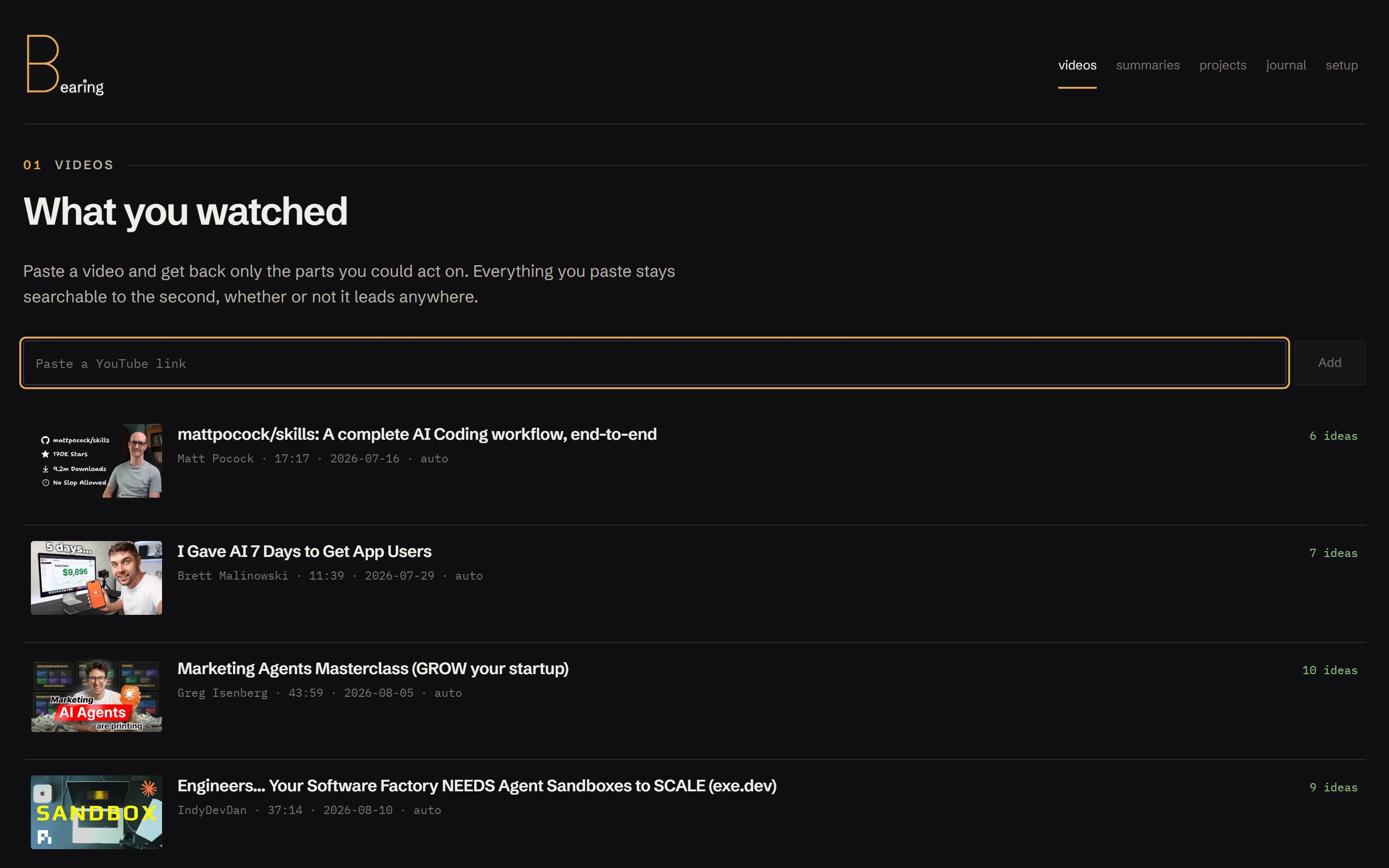
What it does: Paste a YouTube link. Bearing transcribes the video and distils it into Findings, then reads your GitHub repositories and points at exactly where each finding could be applied. When something's worth acting on, it writes a Work Order you can hand straight to your coding agent.
Approval comes before proposal
Understand, decide, apply — and the order matters. Reading a video is cheap. Reading your repository to work out whether a finding applies is not, so nothing expensive starts until you’ve seen what it will cost and agreed to it.
Before a run, Bearing states the arithmetic: three findings across three projects is nine assessments, four at a time, up to ten minutes. It shows the reasoning, not just the number, because a figure with no arithmetic behind it isn’t something you can sanity-check. Projects are capped at three — past a handful you’re not targeting anything, you’re asking the tool to search.
A no is an outcome
An assessment says how a finding lands in a particular project and what acting on it would mean there, resting on the lines of code that support it. Then it opens into a conversation you can interrogate — one that’s allowed to end in no, recorded with your reason.
A button can’t carry an understanding. If you can’t question either the technique or how it lands, you approve everything on trust and the gate is decoration.
What you approve becomes a work order pinned to the project’s current state, which your own agent carries out. Writing that order into a project is the only thing Bearing ever writes; everything else is read-only.
Two claims I measured and withdrew
Assessments were supposed to compound — read a project once, then only its new commits. Measured in August: across eight findings, only five of the ninety places the tool looked were looked at twice. Findings don’t share their questions, so each goes almost straight to different ground. The claim came out of the docs.
The time estimate used to scale with project size. Nothing had ever measured whether size predicts how long an assessment takes, so that came out too.
Why codebases only
Not because they’re the biggest opportunity, but because verification is free there — tests, typecheck, build and diff all prove whether a change worked. Where verification is impossible, every proposal is just an opinion.
TypeScript, React and SQLite, running locally. Working end-to-end.