Case file · The professional platform
Tru8
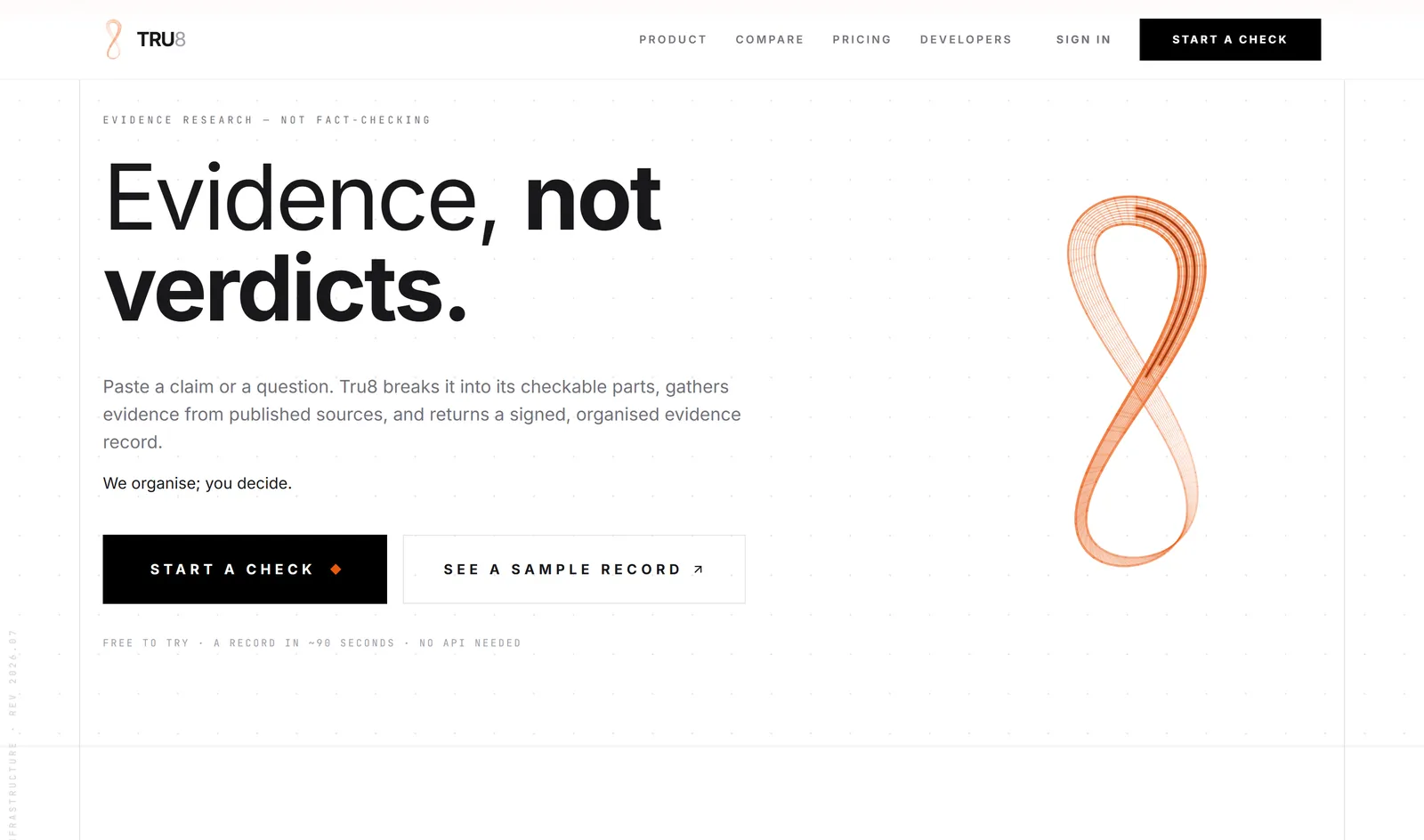
The problem: Checking what's actually true takes hours of digging through sources of wildly different quality. Tru8 does the digging: give it a claim, and it gathers evidence from the open web and specialist APIs, sorts it by how close each item sits to the facts, and hands you a signed record.
The principle: It never tells you what to think. It organises; you decide.
A deliberate pause
Give Tru8 a URL and the first pass only reads: it pulls the page apart into verifiable claims, ranks them, then stops and asks which ones you want investigated.
That pause is bad for a demo. It’s there because the alternative is a machine deciding which claims in your article are worth checking.
The second pass runs per claim — decomposition into separately testable elements, retrieval across web search and specialist APIs, then mapping each piece of evidence onto the element it bears on, as support, challenge or context.
No verdicts
Sources get two labels: a tier (primary, reporting, commentary) and a type (data, official, news, analysis, opinion, academic). Both describe what a source is. Neither says how much of it to believe.
Living with that rule is the hard part. A government dataset challenging a claim probably should outweigh three blog posts supporting it, and the data to weight it that way is already stored. I haven’t, because weighting sources is exactly the judgement the product promises not to make. It’s published as metadata instead, so you can do it yourself.
The limits
- Long documents are truncated before claim extraction, so the back half of a long investigation never gets read — the least recoverable limitation in the system.
- Retrieval runs under hard timeouts, so obscure topics, which need the most evidence, are the likeliest to come back thin.
- Much of the open web blocks automated readers. Where full extraction fails, Tru8 records that it only got a snippet rather than passing a fragment off as a document.
Everything it drops is stored with the reason, and shown to you.
FastAPI, Next.js, PostgreSQL. An MCP server so agents can call it directly, and a signed manifest on every completed check. In active build, not open yet.